Landholder Update 2026
In this edition of our Landholder Update, we explore evolving environmental authorisations for coal seam gas activities, carbon farming opportunities, new social requirements for renewable energy projects, a Land Court ruling with a human rights dimension, and the uptick in CSG exploration in the Taroom Trough.
Understanding changes in environmental authorities for Coal Seam Gas Projects
In recent years, there has been a significant shift in the terms of environmental authorities (EAs) issued for coal seam gas (CSG) projects in Queensland. Previously, alternative arrangements under EAs were limited to “contracting out” of noise impacts at sensitive places. This allowed a CSG proponent and an affected landholder to enter into an agreement permitting CSG companies to exceed their noise limits at sensitive receptors. These alternative arrangement agreements included measures to mitigate the impact of noise or provide alternative accommodation for the affected period, or compensation in lieu of these measures.
However, the terms of EAs have now expanded the scope of alternative arrangements to include other environmental nuisances such as dust, odour, light and smoke. This change has important implications for landholders, particularly those negotiating Conduct and Compensation Agreements (CCAs) with gas companies.
Can environmental harm be caused if an alternative arrangement is in place?
Under the Environmental Protection Act 1994 (EP Act), environmental harm is defined as any adverse (or potential adverse) effect on the environment, whether temporary or permanent and includes “environmental nuisance”. While alternative arrangements may allow for certain environmental nuisances to occur which would otherwise be an unreasonable interference to a quality or characteristic of the environment (e.g. due to the level of and extent of smoke emissions), they do not permit environmental harm as defined under the EP Act. This means that if no alternative arrangement is in place, the company must adhere strictly to the EA conditions to avoid causing environmental harm.
The importance of obtaining good advice
For landholders, entering into a CCA under the Mineral and Energy Resources (Common Provisions) Act 2014 is a critical step when dealing with gas companies. These agreements often include terms for alternative arrangements regarding environmental nuisances. However, it is essential to understand that entering into such arrangements is not mandatory. If no alternative arrangement is agreed upon, the gas company remains bound by the conditions of its EA. Given the complexity of these agreements and the potential long-term impacts on your property and livelihood, obtaining independent legal advice is crucial. A legal professional can help you:
- understand the terms and implications of the proposed CCA;
- assess whether the alternative arrangements being offered are in your best interest; and
- ensure that your rights and interests are adequately protected.
Landholder’s legal fees are payable by CSG companies in the negotiation and preparation of CCAs.
Key takeaways for landholders
- Alternative arrangements are optional: You are not obligated to agree to alternative arrangements for environmental nuisances. If no agreement is reached, the gas company must comply with its EA conditions.
- Environmental harm is prohibited: Even with alternative arrangements, gas companies cannot cause environmental harm which is not authorised by their EA.
- Seek legal advice: Before signing any agreement, consult with a legal expert to fully understand your rights and the implications of the terms being proposed.
By staying informed and seeking professional advice, you can ensure that your interests are safeguarded while
navigating the complexities of coal seam gas projects and their environmental impacts.
Carbon farming and nature repair project opportunities
As political focus continues to sharpen around energy generation and meeting carbon emission reduction targets, opportunities exist for landholders to be involved in projects that have beneficial outcomes for individuals, communities, and the environment and also generate valuable “credit units” or certificates which can be traded on regulated Australian markets.
For landowners (with or without other project proponents), opportunities may exist to undertake “carbon farming” projects. Carbon farming is the undertaking of agricultural activities or changing land management practices:
- to reduce carbon emissions and absorb carbon dioxide from the atmosphere: by undertaking activities such as land reforestation, increasing carbon stored in soil in accordance with accepted methodologies or preventing the release of greenhouse gases by managing livestock emissions through dietary changes and waste management;
- to create “carbon sinks” and improve environmental outcomes: by having, for example, new areas of vegetation and forestation, healthier soils and more robust coastal ecosystems; and
- where a project is registered with the Clean Energy Regulator and credited with carbon emission reduction outcomes, generate “Australian Carbon Credit Units” (ACCU), which are valuable commodities that can be traded and sold on a regulated market (similar to the share market) to a third party who is required to offset their carbon emissions.
For a carbon project to be registered with the Clean Energy Regulator and generate ACCUs, the project is required to be undertaken in accordance with an approved “method”. Over the last year or so, the Clean Energy Regulator has encouraged and been receptive to proponents developing and leading the method development and implementation process, which is intended to make methods:
- more adaptable to changing circumstances and technology advancements;
- to foster innovation by project proponents and bespoke project requirements or benefit opportunities; and
- potentially provide for minor changes to existing methods to be approved more easily than through a legislation variation/parliamentary scrutiny process.
The size and success of a project in actually removing carbon dioxide from the atmosphere (or avoiding the carbon dioxide being emitted in the first place) will determine the number of ACCUs generated. The value of each ACCU is determined by the trading market and of course is influenced by demand and supply.
Other benefits of undertaking carbon farming projects include:
- enabling landholders to generate new, regular income streams through the carbon farming project;
- increasing employment opportunities through active, on-ground management; and
- using the knowledge of landholders to combine land management understanding and science with modern technology to create carbon offsets and new economic and investment opportunities.
In addition to ACCU-generating projects, the federal government has created the “Nature Repair Market”, which enables people to undertake registered projects which improve biodiversity outcomes and generate certificates that can be traded on a voluntary national market via the Biodiversity Market Register. These projects can be undertaken on land or waters, or both.
This new market creates opportunities for landholders, organisations and investors to participate in projects that have benefits similar to carbon farming projects.
In the second half of 2025, the Clean Energy Regulator announced that the first project had been registered under the Nature Repair Market scheme – which is expected to restore 438 hectares of previously cleared land through the replanting of native forest and woodland ecosystems (in accordance with the accepted replanting method for the scheme).
If you are interested in exploring carbon farming or nature repair project opportunities, please do not hesitate to contact us.
New “social” regulatory requirements for wind, large-scale solar and battery storage projects in Queensland
In the second half of 2025, changes to the Queensland planning framework took effect so that applicants for development applications for wind, large-scale solar (being solar farms with a maximum instantaneous electricity output of 1 megawatt or more) and battery energy storage systems (being a battery storage facility that has a maximum instantaneous output of 50 megawatts or more) (BESS) projects must now satisfy additional obligations before their development applications can be lodged.1
The policy intent behind these changes was to obtain benefits for communities and address social impacts where projects of this type are proposed. This in turn will likely result in increased time, costs and complexity for project proponents in undertaking the development assessment process and implementing post-approval requirements.
The changes made to the development application process mean that (among other things), new community benefit system requirements are now in force and require development applications for a material change of use of premises for a wind farm, large scale solar farm or threshold BESS projects to include:
- a social impact assessment (SIA) report, which identifies, analyses and assesses the social impact of the development and complies with the requirements prescribed by regulation. The SIA must be prepared in accordance with, and include, the matters listed in the new Social Impact Assessment Guideline; and
- a community benefit agreement (CBA), with the relevant local government/s about providing or contributing towards infrastructure or another thing in the community or making a financial contribution to the community.
The Social Impact Guideline makes clear that project proponents are to appropriately consider and assess social impacts before a development application is lodged for assessment. The intent of frontloading this obligation is to ensure that commitments made by proponents to address community impacts prior to development assessment are consistent with development applications and factored into any development approval given for a project, including any conditions.
The SIA process is to identify, analyse, assess, manage and monitor the social impacts of a project, both positive and negative. The social impacts of a project are the direct and indirect impacts that affect people and their communities at all stages of the project lifecycle.
The following matters must be addressed as part of a SIA prepared for the purpose of the Planning Act 2016:
• community and stakeholder engagement;
• workforce management;
• housing and accommodation;
• local business and industry procurement; and
• health and community well-being.
For project proponents in your locality that are proposing a wind, large scale solar or BESS with a capacity of 50 megawatts or more, you can expect that they will be engaging in a process to canvass and engage with the community to address SIA requirements. Subject to how a proposed project may impact upon you, your landholding or your business operations, participation in that process could result in the requirement for those impacts to be mitigated as part of the project approval requirements.
If the renewable energy projects are to be developed on your land, ensuring that the options and tenure documents provide flexibility and commercial certainty in dealing with these additional project assessment requirements and longer timeframes are suggested.
Separate to any SIA requirements required as part of a development application process, we are aware that landowners near to renewable energy projects have variously been approached to enter into commercial arrangements with project proponents on the basis of mitigating project impacts. Entering into these types of arrangements are not required as part of any development approval process and care should be taken in considering these agreements and how they may affect you.
Please contact us if you have any queries or would like to discuss these processes further.
Community voices may make a difference
The recent case of Rolleston Coal Holdings Pty Ltd v Department of Environment, Tourism, Science and Innovation [2025] QLC 22 highlights the significance of the Land Court’s obligation to consider the submissions of non-active objectors and provide well-reasoned recommendations to statutory decision-makers. It also reaffirms the court’s requirement to consider the effect of Green House Gas (GHG) emissions on human rights.
Rolleston Coal Holdings Pty Ltd is a mining company owned by Glencore PLC (Applicant). The Applicant made an application to amend its Environmental Authority (EA) to expand its coal mining operations and access an additional 33.7Mt of coal.
The application to amend the EA triggered provisions within the Environmental Protection Act 1994 which enabled community groups and individuals to make submissions and/or elect to be a party to the proceedings. In response to the public notification process, submissions opposing the application were made by several organisations including Lock the Gate Alliance (LTGA) and Environmental Advocacy in Central Queensland (EACQ).
Following their submissions, LTGA and EACQ elected to be non-active objectors meaning that, although they would not actively participate in the hearing, their submissions would be considered by the court who would then provide a recommendation to the statutory decision maker to either approve or reject the application.
In its submissions LTGA identified that the Applicant had used incorrect figures in their application resulting in a dramatic underestimation of GHG emissions. The court agreed with LTGA’s submission with Member McNamara stating, ‘it is alarming that a global mining company such as Glencore can make such a basic error in their calculations. It was not a small error; it was an error by a significant factor.’. The submission forced the Applicant to amend their application by correcting calculations and providing further documentation to the court.
LTGA and EACQ also made submissions about the application’s potential impact on human rights. Member McNamara relied on the case of Waratah Coal Pty Ltd v Youth Verdict Ltd & Ors2 to establish the obligation of the court to make decisions consistent with the provisions of Human Rights Act 2019 and then referred to the case of Pabai v Commonwealth of Australia3 as authority for direct and indirect GHG emissions contributing to climate change.
The court then proceeded to consider whether GHG emissions and their contribution to climate change infringed on human rights and whether mitigating measures could offset these contributions. The court considered the Applicant’s GHG mitigation measures and the terms of the EA within the context of Re Sungela Pty Ltd & Anor and BHP Coal Pty Ltd & Ors v Chief Executive, Department of Environment, Science and Innovation.4
The court found that GHG emissions negatively impact human rights. However, the court determined that in this instance the proposed operations and any resulting GHG emissions would represent an insignificant proportion of global GHG emissions and therefore any impact on human rights would be proportionate.
While ultimately the court’s recommendation was for the application to be approved, it demonstrated the ability for community organisations to have factual errors scrutinised and human rights implications considered without committing community organisations to litigation.
Taroom Trough exploration – Watch this space.
On 10 February 2026 the Crisafulli government announced Omega TN Pty Ltd, Tri-Star Stonecroft Pty Ltd and Drillsearch Energy Pty Ltd (the Tenderers) had been appointed preferred tenderers for an exploration tenement in the Taroom Trough.5
The exploration tenement is located approximately 30km south of Miles and covers an area of approximately 750km2. The eastern and western boundaries of the exploration tenement are approximately 46km in length and encompass the town of Condamine in the northeastern section. The northern and southern boundaries of the exploration tenement are approximately 16km in length with the northern boundary running parallel to the Roma Condamine Road and the southern boundary extending to within 2 to 7km of the Surat Development Road.
To commence activities within the exploration tenement the Tenderers will need to hold an Authority to Prospect (ATP) issued under the Petroleum and Gas (Production and Safety) Act 2004 (P&G Act). The Tenderers will also need to obtain an Environmental Authority (EA) pursuant to Environmental Protection Act 1994 (EPA Act).
Landholders do not have a right to object to the application under the P&G Act. If the Department of Environment, Tourism, Science and Innovation (DETSI) determines that the EA application is for a ‘site-specific’ (‘high risk’) project, Landholders may have rights to make submissions during public notification process under the EP Act. However, it is not unusual for EA applications for ATPs to be classified as “standard” applications, which do not give rise to submission rights.
If a submission can be made, Landholders will typically have 20 business days from publication of a public notice to do so unless another time is fixed by the administering authority.
If Landholders or interested parties can and want to make submissions about any site specific EA application, they should monitor DETSI’s website for the publication of a public notice concerning ATP 2081: https://www.detsi.qld.gov.au/our-department/public-notices
Assuming the Tenderers satisfy the requirements for the ATP and the EA, Landholders within the boundaries of the exploration tenement should prepare to receive a notice from Tenderers advising that they will be conducting “Preliminary Activities” (activities with limited impact on Landholders – e.g. taking soil/water samples, walking the property or survey pegging) or correspondence seeking to negotiate Conduct and Compensation Agreements (CCAs) to enable the undertaking of “Advanced Activities” (activities with longer term impacts on Landholders – e.g. seismic surveying with vehicles and machinery, clearing of land or constructing access tracks).
Landholders may, in certain circumstances, have grounds to dispute access notices for Preliminary Activities and can negotiate the terms of CCAs for Advanced Activities. Legal costs for the negotiation of CCAs will generally be payable by the Tenderers.
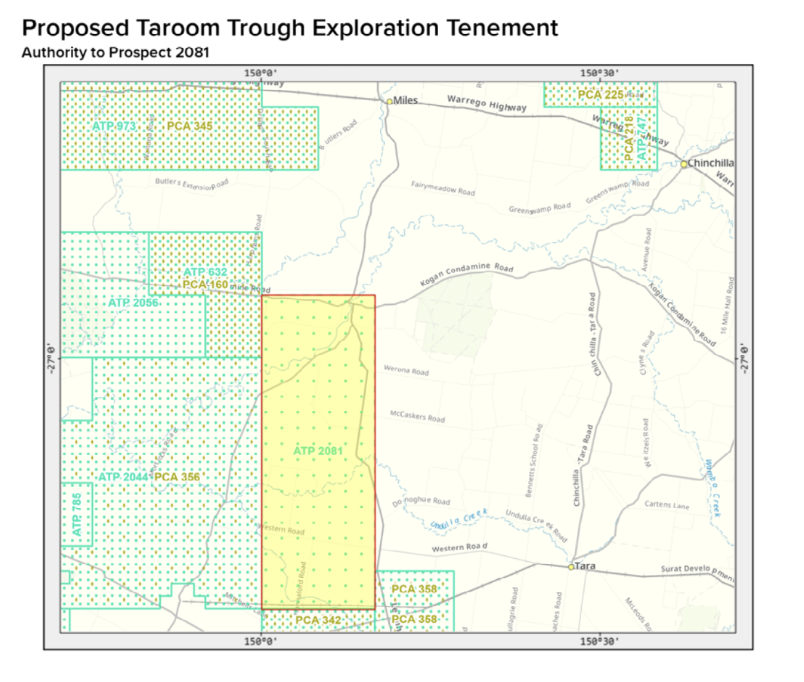
Map of Proposed Taroom Trough Exploration Tenement6
- The obligations also apply to applications to change existing development approvals (other than for changes which are for a “minor” change under the planning legislation). ↩︎
- Waratah Coal Pty Ltd v Youth Verdict Ltd & Ors (No 1) [2020] QLC 33. ↩︎
- Pabai v Commonwealth of Australia (No 2) 2025 FCA 796. ↩︎
- Re Sungela Pty Ltd & Anor [2025] QLC 5 and BHP Coal Pty Ltd & Ors v Chief Executive, Department of
Environment, Science and Innovation [2024] QLC 7 ↩︎ - Dale Last (Hon), ‘Crisafulli Government opens the valve on Australia’s first potential major oil province in
a generation’, The Queensland Cabinet and Ministerial Directory (Media Statement, 10 February 2026) https://statements.qld.gov.au/statements/104470. ↩︎ - Queensland Government, ‘Proposed Taroom Trough Exploration Tenement’, GeoRes Globe (Online Map, 13 February 2026) https://georesglobe.information.qld.gov.au/. ↩︎
If you have any questions, please do not hesitate to contact John Heaney, Thomas Habel, Anna Vella or Matt Patterson.
All references to legislation are references to the legislation current as at 17 Feb 2026. This is general advice only. Specific advice should be sought in each instance.
© Feb 2026.