Fresh Perspectives from the Planning Institute of Australia’s Qld State Conference in Cairns
Our team of planning lawyers recently attended the Planning Institute of Australia’s Queensland State Conference, held on Gimuy Walubara Yidinji Country at the Pullman Cairns International. Just a short walk from our Cairns office, the conference brought together planners, lawyers, landholders and other industry experts to examine current issues shaping planning in Queensland. For the P & E Law team, it was a great opportunity to hear perspectives from beyond the legal profession and gain current insights into emerging planning ideas and their implications for development, communities and the environment.
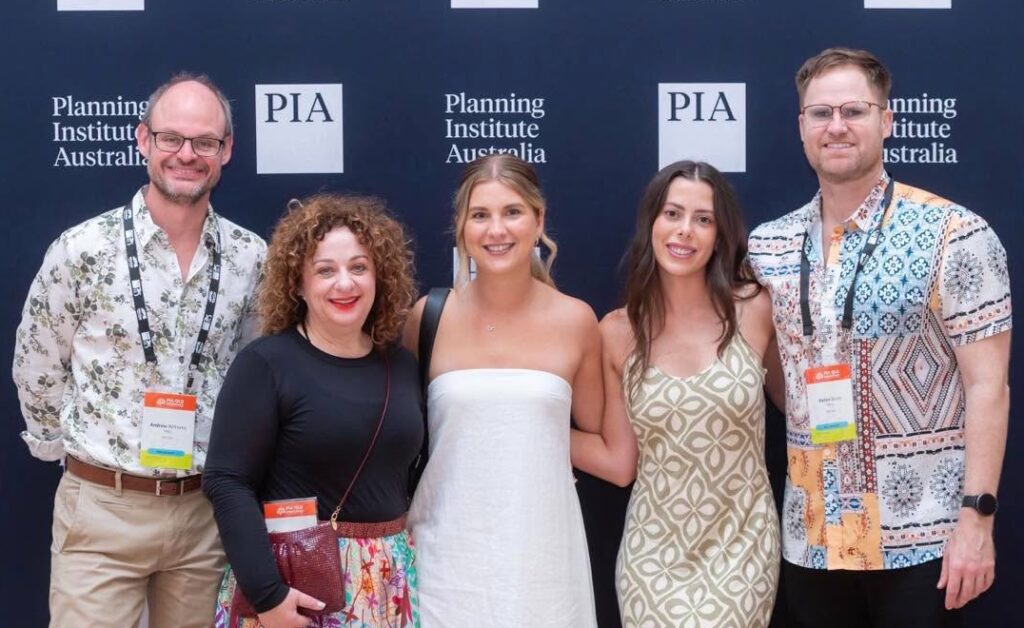
Our Planning team attending were Andrew, Anna, Tara, Georgia and Aaron (pictured). And also Tanya, Danielle & Lestar. [Photo by Element Photo and Video Productions.]
The conference program covered sustainable development, adaptive planning, climate change, infrastructure planning, waterways, flooding, renewable energy, placemaking, greenfield development and artificial intelligence (AI). Below are some of the conference highlights.
FRESH APPOACHES TO SUSTAINABLE PLANNING
Sustainable development and climate-responsive living were recurring themes throughout the conference. Common threads in the presentations considered planning pathway options in the context of uncertain futures and the importance of avoiding siloed responses in an ongoing changing environment. Exploration, flexibility, adaptability and catalysts requiring adjustment were discussed as important factors for meaningful shifts and responses to development pressures.
Presenters explored a wide range of practical and novel approaches to the way Queensland’s cities, housing and infrastructure could be planned.
Innovative ideas included:
- the incorporation of rooftop solar infrastructure into inner-city high-rise developments, placing renewable energy facilities closer to large numbers of consumers. An impressive improvement on renewable energy being provided from solar farms which typically require extensive rural land, vegetation clearing, modification of natural landforms and transmission of electricity over great distances.
- implementing strategies for heat resilient affordable housing. Examples included development applications for duplexes and quadplexes whose siting, footprint and design resulted in heat minimization outcomes. Detached and semi-detached layouts offered an alternative to the conventional row of four attached rectangular dwellings, creating greater opportunities for airflow and shade from vegetation. With heat contributing to more deaths than any other natural hazard, these examples demonstrated how development assessment and housing design can support healthier, more resilient communities.
FRESH PRESPECTIVES ON EPBC ACT REFORMS
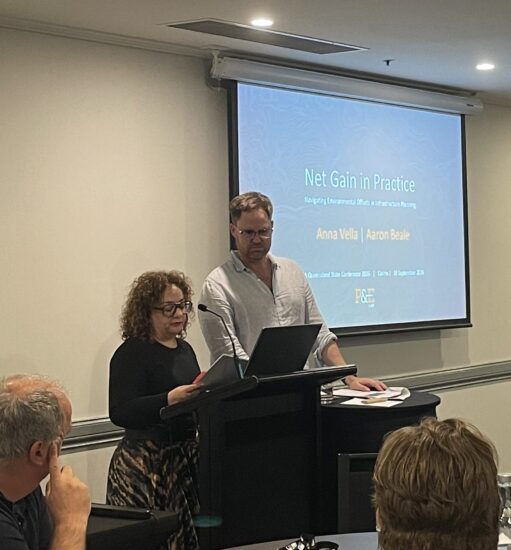
P & E Law team members Anna Vella and Aaron Beale presented on reforms to the Environmental Protection and Biodiversity Conservation Act. Their presentation examined the deficiencies of the previous legislative framework and the reasonings for reforms. Anna and Aaron then compared the treatment of environmental offsets before and after the amendments, with particular attention to the concept of a “net gain” requirements for the environment. Through practical examples, they demonstrated how considering the Act’s new provisions at the beginning of a project can support better outcomes for both the environment and project delivery.
FRESH FORMATS FOR AUDIENCE FEEDBACK
A notable feature of the conference was the inspiring, fresh and uplifting styles adopted by presenters across the program. Their enthusiasm and creative delivery brought energy to the sessions, broke down complex subject matter and provided a forum for the audience to engage with important issues in planning. Some presentations provided for audience real time participation with the use of interactive presentation platforms to gather feedback. For example, one presentation had audience members submit their emotional responses via a QR code after being shown a series of photographs of land and built form in various planning contexts. The results were collated in real time enabling the presenter to respond to the audience’s input as it emerged. This engaging format may also have a potential application for local government community consultation meetings wherein the same technology could be used to capture and display participants’ immediate feedback.
FRESH FOOD FOR THOUGHT: AGRICULTURE AND CLIMATE CHANGE
Food security in the face of climate change was another important conference theme. Landholder Caitlin McConnel of Cressbrooke Station emphasised that food production is essential to climate resilience. She noted that food production areas are often overlooked in the planning regime and argued they should be at the forefront rather than being treated as an afterthought. State planning policy, planning schemes, development assessment and environmental offsets can all affect productive agricultural land and food security. Ms McConnel explored the legal dimensions of food security, connecting the human right to food with the Paris Agreement and made the memorable observation: “Hunger is a powerful weapon at law.”
FRESH TIPS ON WELLBEING
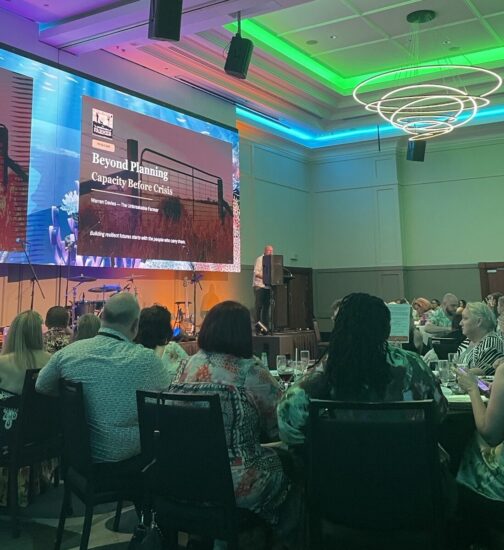
Thursday evening’s keynote was delivered by Warren Davies, “The Unbreakable Farmer”. Although his presentation was outside the conference’s technical planning content, through sharing his own personal stories he conveyed an important message about resilience, wellbeing and life under pressure, which had broad professional relevance. He stressed the importance of having meaningful conversations about mental health, checking in with those around you regularly, and asking open ended questions, not simply “are you ok?”. Mr Davies spoke about 10 specific areas of ‘wellbeing’, which included things like vocational fulfillment and physical health, emphasising the importance of maintaining balance across all areas to optimise resilience. These key areas of wellbeing were broken down into a Wheel of Wellbeing exercise which enabled the audience to consider whether their ‘wheels’ were aligned. His Wheel of Wellbeing exercise particularly resonated with the team as a useful way to reflect on emotional wellbeing, and the tool was subsequently shared with our colleagues across P & E Law.